Most environmental impacts are assessed in a structured way. Projects are reviewed, their effects analyzed, and decisions are made about whether those effects are acceptable. That process is necessary, and often rigorous.
But it also has limits. Over time, multiple activities begin to interact, and ecosystems shift in ways no single project fully explains. That is where cumulative effects come in, and why the scale at which we approach them matters.
First things first: what are cumulative effects?
Cumulative effects can be understood as environmental changes caused by multiple human activities and natural processes that accumulate across space and time. More colourfully, cumulative effects are often regarded as environmental death by a thousand cuts.
Cumulative effects assessment, meanwhile, is the process of identifying, analyzing and evaluating those effects. These definitions point toward a systems view of environmental management and fit naturally with ecosystem-based management, which focuses on ecosystems as a whole rather than on one project at a time.
Environmental and Climate Change Canada published an elegant video explaining cumulative effects in plain terms:
From a policy and regulatory standpoint, however, cumulative effects are often defined more narrowly as the environmental effects of a project in combination with other projects or activities. That definition is designed for project appraisal rather than for managing a whole watershed, coast, or region.
This distinction is important because, in practice, cumulative effects assessment almost always takes place at the scale of individual projects unless it is explicitly conducted as a regional or strategic assessment.
Why project-scale cumulative effects assessment became the default
Environmental impact assessment (EIA) regulatory processes are organized around projects. A project has a proponent, a footprint, a timeline, a review process, and a decision point.
Within that regulatory framework, cumulative effects become one part of project appraisal. The main question is whether a proposed development is likely to add significant pressure to an environment already affected by other activities and processes.
That is a legitimate question, and project-scale cumulative effects assessment remains an important part of environmental oversight. It can help identify incremental effects, support mitigation, and guide follow-up and monitoring.
More often than not, however, the conclusion is that the project is unlikely to contribute significant adverse effects, and the project proceeds. As such, cumulative effects within project appraisal can easily become a box to check rather than a framework for understanding how pressures accumulate to affect an entire region.
Looking Through the Wrong End of a Funnel
The deeper issue is one of scale. Cumulative effects accumulate across regions and over decades, yet project-scale assessment asks whether one project adds significant pressure within that broader picture. That is too narrow if the goal is environmental management.
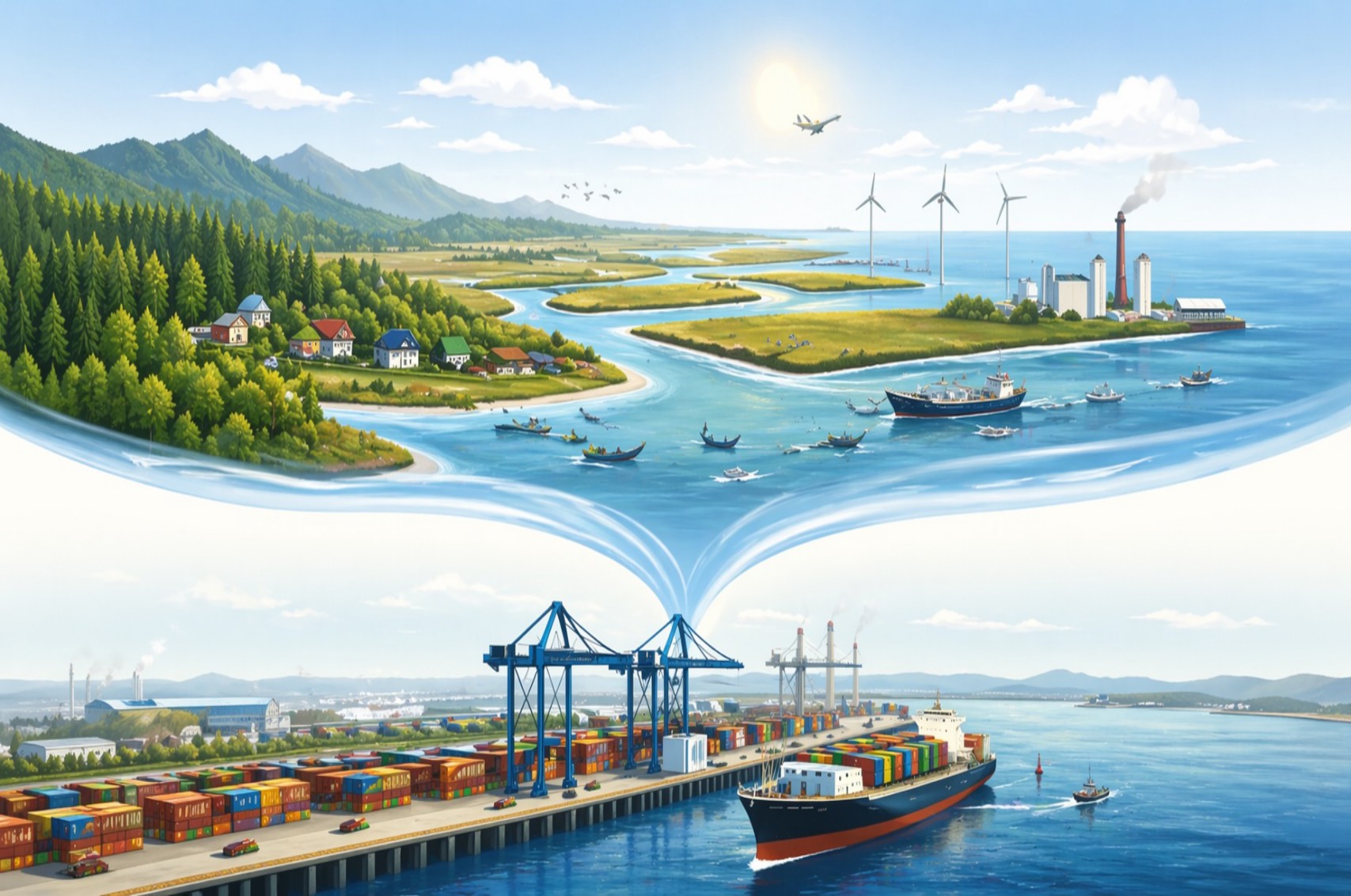
For environmental management, the region should frame the project, not the other way around. Put differently, project-scale cumulative effects assessment looks through the wrong end of a funnel. It begins with one project and expands outward just enough to account for the broader context surrounding it.
That distinction matters because environmental management asks regional questions. Which valued components are already under the most pressure? Which stressors dominate risk? Where are the main pathways of effect? Where should mitigation, monitoring, or planning be prioritized? These questions are much closer to ecosystem-based management. While project appraisals can contribute to them, they cannot, nor should they be expected to, answer them on their own.
This is precisely why regional and strategic approaches to cumulative effects assessment are needed. Regional or ecosystem-scale cumulative effects assessment starts at the wide end, with the region itself and the burden already carried by the system. Only then does it ask what an individual project means within that larger picture.
More broadly, it is also why the responsibility for contextualizing projects within a whole region cannot rest solely on project proponents. That responsibility belongs more fundamentally to governments and broader environmental management processes.
What Ecosystem-Scale Assessment Makes Possible
Regional and ecosystem-scale approaches to cumulative effects assessment ask a different question. Rather than asking whether one project adds to existing effects, they ask how multiple activities interact across a whole region and what that means for environmental management.
This broader perspective changes the kinds of questions an assessment can answer. A regional cumulative effects assessment can help identify:
- the current state of a region
- the valued components most at risk
- the dominant pathways of effect
- the activities contributing most strongly to those risks
- the areas where mitigation, monitoring or planning should be prioritized
In that sense, regional and project-scale cumulative effects assessments should not be viewed as competing approaches. Regional assessment provides the context that makes project-scale assessment more meaningful.
Regional assessments are also gaining traction in Canada, including the Ring of Fire regional assessment in Ontario and the ongoing St. Lawrence regional assessment in Québec. These processes are still evolving: data gaps remain, causal pathways are not always well established, and implementation is far from perfect. Still, they are much better aligned with the broader management challenge cumulative effects were supposed to address in the first place, and they are a much-needed tool for ecosystem-based management.
Working Across the Funnel
At inSileco, much of our cumulative effects work sits at the ecosystem scale. Our experience includes ecosystem-scale assessments of food webs in the Estuary and Gulf of St. Lawrence and the Scotian Shelf in Canada. It also includes assessments of maritime activities in the St. Lawrence.
But our goal is not simply to work at the wide end of the funnel. It is to help connect that broader regional understanding back to project appraisal. In practice, that means developing the tools, data structures, analytical workflows, and decision-support systems needed to properly contextualize projects within a broader regional or ecosystem-scale assessment.
In that sense, our work is concerned with the whole funnel: from ecosystem-scale assessments that identify cumulative risk across regions, to the infrastructure needed to make that context usable when specific projects are being reviewed. For us, cumulative effects assessment is not only about producing better regional analyses. It is also about making those analyses operational and building a system for managing risk over time.
Have a topic in mind or want to stay up to date with our work?
Let us know!