
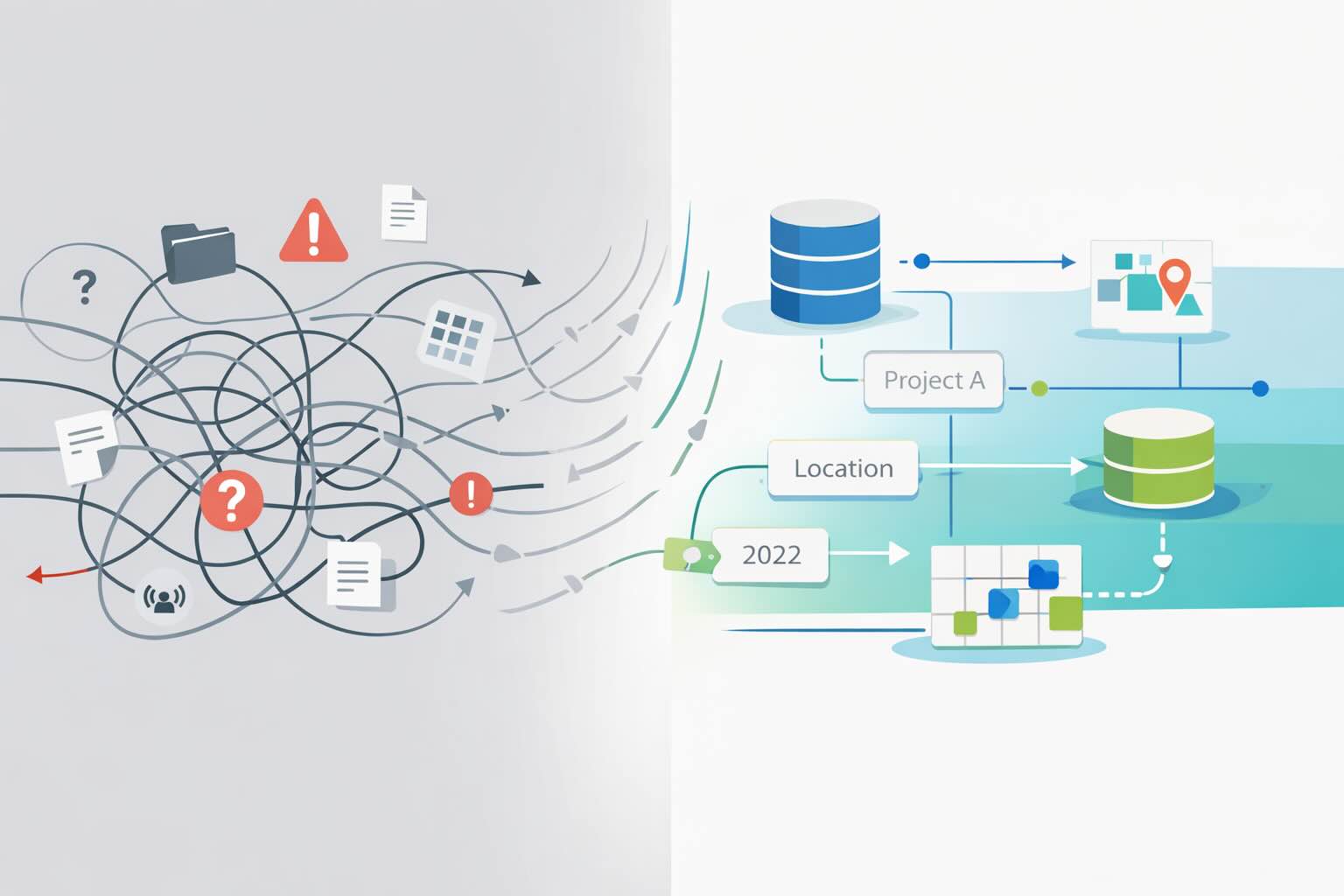
Everyone agrees that data management is important.
Yet in practice it often feels like a burden: files end up scattered across personal folders, metadata (data about data) is incomplete, and meeting reporting or administrative requirements turns into a scramble at the end of a project.
After years of working with academic teams, government agencies, industry partners, and Indigenous organizations, we keep seeing the same patterns.
Here are six principles that consistently separate data systems that work from those that slowly fall apart.
1. Data management is a behavioral problem
Data management is often treated as a technical problem.
In reality, it is mostly a behavioral one.
Effective data management requires people to consistently perform small but essential tasks:
- naming files clearly
- organizing folders
- documenting datasets
- recording metadata
- keeping track of versions
Yet they are necessary if data is going to remain usable over time.
Maintaining these habits requires discipline and consistency, much like exercising regularly or eating healthy – things we know are good for us, even if they are often tedious and unappealing.
Understanding this changes how we design data systems.
The goal is not simply to build infrastructure – although that part is still crucial.
The goal is to support sustainable behavior.
2. Reduce the mental load
The key design principle for effective data management is simple: reduce the cognitive load.
If a data management system requires too many steps, forms, or decisions, people will eventually bypass it.
The same thing happens with overly complex password policies. When security procedures become too cumbersome, people start looking for ways around them.
Successful systems do the opposite. They simplify workflows by:
- minimizing required inputs
- using clear conventions
- automating repetitive tasks
- integrating into existing workflows
In other words, good systems remove friction instead of adding it.
When data management becomes easier than not doing it, adoption follows naturally.
3. Tools are not the solution
Many conversations about data management focus heavily on choosing tools or platforms.
But tools rarely solve the underlying problem.
Without clear practices and consistent habits, even sophisticated platforms quickly become disorganized.
Conversely, many effective data systems rely on relatively simple tools:
- shared folders
- structured templates
- lightweight metadata tables
- version-controlled repositories
What matters is not the complexity of the tool.
What matters is whether the system supports good practices that people can maintain over time.
Technology should enable good data management – not replace it.
4. Start earlier than you think. No – earlier than that.
Many data management conversations begin after a project has already started.
By that point, data structures are already inconsistent, important context is missing, and reorganizing everything becomes difficult.
The most effective strategies begin much earlier – often at the proposal stage.
This does not require building complex infrastructure upfront. Instead, it means agreeing early on a few basic principles:
- how data will be organized
- what minimal metadata will be recorded
- how datasets will eventually be archived or shared
Small strategic decisions made early prevent large problems later.
5. Metadata is a strategic asset
Metadata is often treated as documentation that can be written later.
In reality, metadata is the key asset that allows datasets to be discovered, understood, and reused.
Without metadata, datasets quickly become difficult to interpret – even for the people who originally collected them.
In collaborative projects especially, metadata plays an even more important role. It allows diverse datasets to be indexed, connected, and explored across projects – much like tags or categories make information discoverable on the web.
In practice, this usually means capturing a small set of shared descriptors, such as who collected the data, where and when it was collected, what variables were measured, and how the data can be accessed.
This minimal layer of shared information allows coordination without forcing full standardization and creates the foundation for data interoperability across disciplines.
6. Coordinate without rigidity
Many teams try to solve data management by building a single centralized system where everything must fit.
This rarely works.
Different teams collect different types of data, use different tools, and operate at different scales. Forcing everything into a rigid structure tends to create friction rather than coordination.
Overly complex or rigid systems can also create another problem: dependency on a small number of people who understand how they work. When those individuals leave a project, much of the institutional knowledge can disappear with them.
More effective systems allow project autonomy while enabling coordination across the team or network.
This often involves modular infrastructure, shared conventions, and metadata systems that connect datasets without forcing them into the same format.
Systems that are simpler and more transparent are easier for teams to maintain collectively.
The goal is not uniformity.
The goal is interoperability.
Designing systems people will actually use
Across sectors, the same lesson keeps emerging: data management systems succeed when they are designed around people, not just technology.
Infrastructure matters, but so do habits, incentives, and cognitive load. Systems that require too many steps, too many forms, or too many decisions rarely survive long in real-world environments.
The most effective approaches take the opposite path. They simplify workflows, reduce friction, and make good practices easier to maintain over time.
In the coming posts, we will explore these ideas in more detail and share practical approaches teams can adopt to make data management simpler and more sustainable — from metadata hubs and interoperable data systems to lightweight workflows that reduce friction for researchers and project teams.
Because in the end, effective data management is not about building the most sophisticated system.
It is about building systems that people will actually use.
Have a topic in mind or want to stay up to date with our work?
Let us know!